

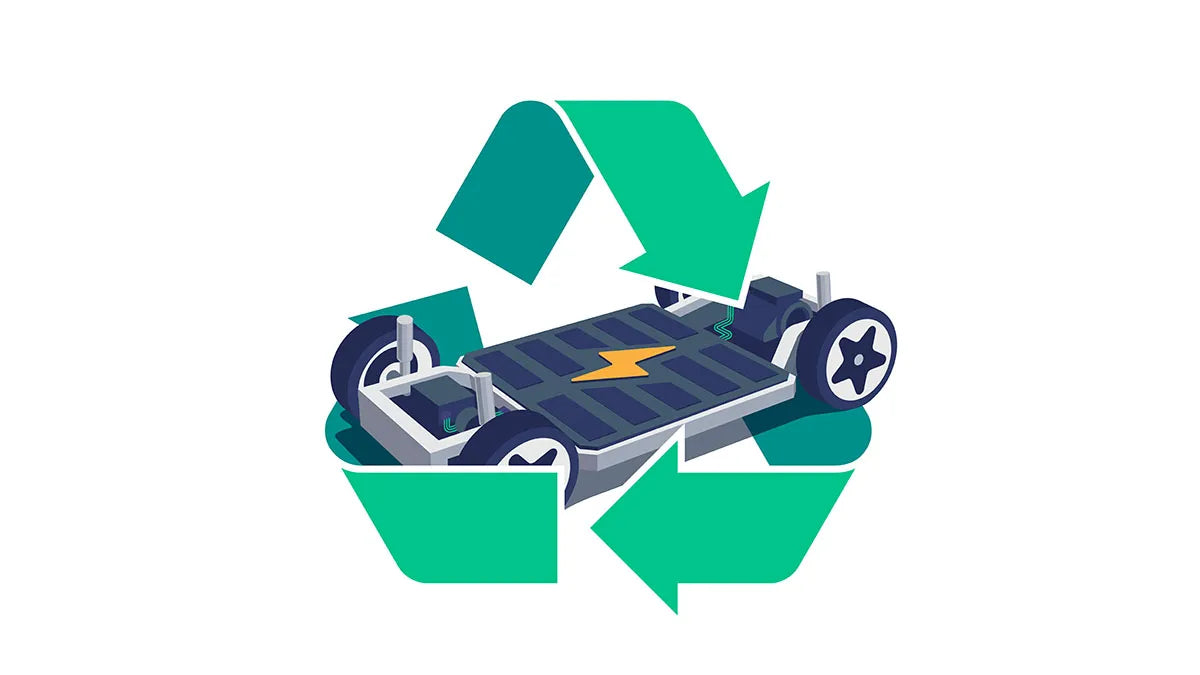
Rising Demand for Batteries in Europe
The demand for batteries is growing rapidly worldwide. According to estimates by the European Commission, global demand could be about fourteen times higher by 2030 than it is today. Around 17% of this demand is expected to come from the European Union.
To meet this demand, the production of new batteries alone is not sufficient. In addition to manufacturing new cells, the recycling of used batteries is therefore becoming increasingly important. This involves either the direct reuse of entire batteries or the recovery of valuable raw materials for new energy storage devices.
Recycling is therefore considered an important component of the European strategy to improve security of supply while reducing environmental impact.

New EU rules increase recycling requirements
An important step was taken in 2023 with the entry into force of the EU Battery Regulation (EU 2023/1542). This regulatory framework sets stricter sustainability standards for batteries and obliges manufacturers and recyclers to achieve higher recovery rates.
By 2030, large quantities of critical materials are to be recovered from end-of-life batteries. The target values are at least 70% for lithium and 95% for cobalt, nickel, lead, and copper.
In addition, recycling companies must achieve certain efficiency rates. These include, among others:
-
80% recycling efficiency for lead-acid batteries
-
70% for lithium batteries
-
80% for nickel-cadmium batteries
-
50% for other battery types
These requirements aim to ensure that batteries become more sustainable throughout their entire life cycle.
E-mobility increases long-term battery demand
The political framework for e-mobility in Europe will generate additional demand for batteries in the coming years. An important factor is the planned ban on new vehicles with internal combustion engines from 2035 in the European Union.
With the increasing electrification of transport, the number of batteries in circulation is rising significantly. At the same time, a growing stock of end-of-life batteries is emerging in the long term, which can either be recycled or reused.
A research team reported in a study in the journal Nature Communications that between 2.1 and 4.8 TWh of former EV batteries could be available by 2050.
Interestingly, many of these batteries still have 70-80% of their original capacity even after their use in the vehicle.
Second life for EV batteries as stationary energy storage
Even if used batteries are often no longer suitable for use in electric vehicles, they can still be used in stationary energy systems. Applications range from grid storage and industrial energy systems to solutions for renewable energies.
By combining several used batteries, larger storage systems can be built. Since stationary systems have less stringent requirements for charging and discharging rates, batteries can be used significantly longer here.
The mentioned study estimates that reused vehicle batteries could provide a storage capacity of between 32 and 62 TWh by 2050. This could make a significant contribution to stabilizing power grids.
Companies develop new business models
Several companies in Europe have already developed solutions to reuse used batteries in stationary energy storage systems.
One example is the Swiss company Modual, which uses batteries from electric vehicles for modular storage systems. These systems are often used to store electricity from wind or solar plants during high demand or to provide reserve energy during power outages.
The storage capacity of many installations is below 1 MWh, but the modular concept theoretically allows for significantly larger systems. The company only accepts battery cells with at least 80% residual capacity and checks their condition using special diagnostic methods.
Large-scale battery storage from second-life cells
Another company is Libattion, which reprocesses used EV batteries for large-scale energy storage systems. The developed systems cover capacities from 100 kWh to 100 MWh and are frequently used in industrial or utility projects.
The company currently operates a production facility with approximately 7,000 m² of space, which is considered one of the largest European facilities for so-called battery upcycling. Production capacity is to be significantly expanded in the coming years.
The British company Connected Energy also uses used lithium-ion batteries for energy storage. The smaller system E-STOR, for example, helps to compensate for bottlenecks at EV charging stations during peak times.
For larger applications, the company developed the M-STOR system, which is designed for industrial power storage in the megawatt range.
Further projects in Germany and Europe
New companies are also emerging in Germany around the topic of battery reuse. The start-up Voltfang builds energy storage systems from used EV batteries.
Among its customers is the retailer Aldi Nord, which uses such storage systems to store energy from solar panels on store roofs.
The company plans to achieve a total storage capacity of approximately 1 GWh by 2030.
Robotics facilitates the dismantling of old batteries
Not every battery is suitable for a second use. In many cases, it is more economically viable to dismantle batteries and recover their raw materials.
This is where the company R3 Robotics comes in. The company uses automated systems to dismantle battery packs with the help of robots.
This concept, often referred to as “Disassembly-as-a-Service,” enables a precise analysis of each battery pack. Camera systems and 3D vision technology first identify modules and components within the battery pack.
The system then decides whether the battery should be repaired, reused, or fully recycled. By using robots, the process becomes not only safer but also faster and more scalable.
In the meantime, the company's systems can also dismantle other EV components such as electric motors or power electronics in addition to batteries.

Recycling becomes a key to the energy transition
The increasing importance of battery recycling shows how closely e-mobility, raw material supply, and energy systems are linked.
With stricter regulations, innovative technologies, and new business models, Europe is trying to build a more sustainable battery economy. Recycling and reuse could help to use raw materials more efficiently and at the same time meet the growing demand for energy storage.
In the long term, these measures could significantly contribute to making Europe's energy transition more stable and independent.
Further reading: Chinese electric trucks put pressure on Europe's commercial vehicle industry


Share:
Chinese electric trucks put pressure on Europe's commercial vehicle industry
Strong demand for Volvo EX60: Production to be expanded