

Introduction to European Plug Types
Europe is known for its variety of sockets and mains voltages. Those who travel frequently or use electrical devices from other countries will quickly find that not every socket is compatible. Using the wrong plug type can damage devices or pose safety risks. Therefore, it is important to know the common plug types and their characteristics.
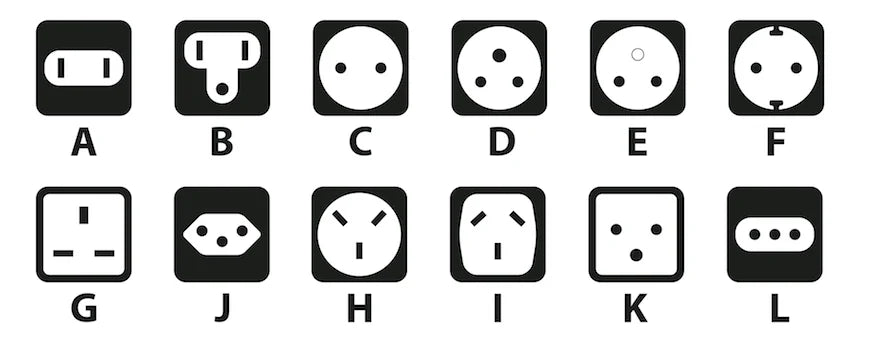
In Europe, there are several standard plug types, which are designated by an international letter system. The most important types are Types C, E, F, G, and L, with Types C, E, and F being the most common. Each country has its own regulations that determine which sockets may be installed.
Type C – The Europlug
The Type C is also known as the "Europlug" and is widely used in Europe. It has two round pins with a diameter of 4 mm and is suitable for devices with low current consumption up to 2.5 A. Type C is ungrounded, which is why it is only suitable for devices with protection class II.
Countries where Type C is common include France, Spain, Italy, the Netherlands, and Sweden. This plug type is particularly practical for travelers, as it is compatible with many older sockets. However, for devices that require higher power, grounded variants should be used.

Type E – With Earthing through Hole
Type E is mainly used in France, Belgium, Poland, and Slovakia. It has two round pins, similar to Type C, but also features an earthing pin that is anchored in the socket. This pin provides additional safety by protecting conductive housings of devices.
The rated current is typically 16 A, and the mains voltage is 230 V. Type E plugs are also partly compatible with Type F sockets, as the two standards are mechanically similar. This facilitates the use of devices in several European countries.

Type F – Schuko for Higher Loads
The Type F, often referred to as "Schuko", is widely used in Germany, Austria, the Netherlands, and Spain. It has two round pins and earthing contacts on the sides, which replace the protective conductor. The maximum current is 16 A, and the voltage is 230 V.
Schuko plugs are suitable for devices with higher energy requirements, such as washing machines, refrigerators, or laptops with chargers. They are robust and offer high safety due to the earthing. In addition, Type F plugs can be used in Type E sockets, as the fit is compatible.

Type G – British Standard
In the UK, Ireland, Malta, and Cyprus, the Type G is used. This plug has three rectangular pins and an integrated fuse element that limits the current flow. The mains voltage is 230 V, and the maximum current is 13 A.
Type G plugs are particularly safe as they automatically activate earthing and prevent overloads. However, adapters are required if devices from other European countries are to be used.

Type L – Italian Special Case
The Type L is predominantly used in Italy and some parts of Switzerland. It has three round pins in a line and is available in two variants: for 10 A and 16 A. The earthing pin is located in the middle and provides the safety function, which is also necessary for high-power devices.
Travelers should note that Type L is not directly compatible with Type C or F, which is why adapters or special travel plugs are required.

Practical Tips for Travellers
- Don't forget adapters: If you're traveling to several countries, you should carry a universal travel adapter that covers Types C, E, F, G, and L.
- Check voltage: Almost all European countries use 230 V at 50 Hz, but for devices from other continents, the compatible voltage should be checked.
- Observe device protection: Especially for high-power devices, a grounded plug should be used to avoid electrical damage.
- Adapter quality: Cheap adapters can cause sparks or overheating. CE-tested adapters are recommended.
Summary
Europe offers a variety of plug types designed to meet different safety and performance requirements. For travelers or users of foreign devices, knowledge of plug types C, E, F, G, and L is essential to ensure compatibility and safety. Choosing the right plug protects both devices and users and simplifies everyday life when using electrical devices internationally.
Further reading: Single-phase vs. Three-phase Charging: How to Choose the Right EV Charging Solution


Share:
Single-Phase vs. Three-Phase Charging: How to Choose the Right EV Charging Solution
Can you charge an electric car using a household socket?