

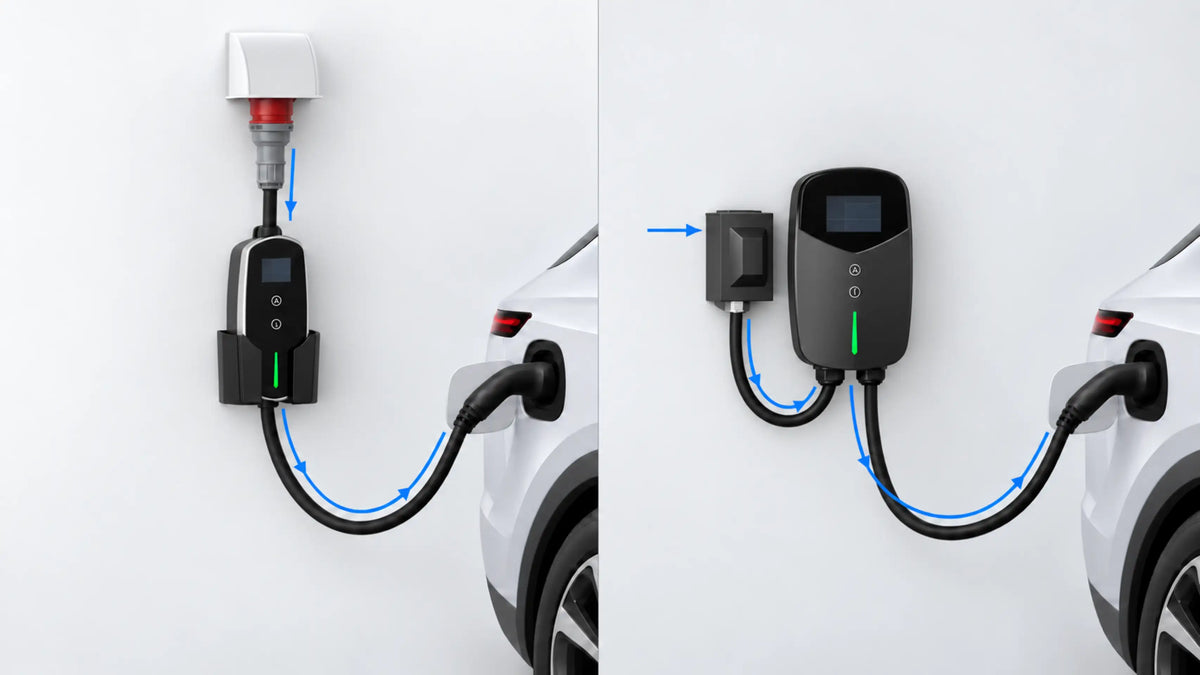
A mobile wallbox is a practical choice when a compatible CEE socket is already available and the charger will be used at more than one suitable location. A fixed wallbox fits better when the vehicle is charged regularly at the same parking space and everyday convenience is the priority.
Both solutions can provide regular AC charging. The main differences are how they connect to the electrical supply, whether they can be transported and how they fit into the driver’s daily routine.
How the Two Solutions Work
A mobile wallbox connects to a compatible industrial socket, such as a CEE socket. It contains the control and safety functions needed to manage charging and can be disconnected after use.
A fixed wallbox is permanently connected to the electrical installation at one location. It remains mounted near the parking space and is ready whenever the vehicle returns.
A mobile wallbox is not automatically less powerful than a fixed model. Both types can provide 11 kW or more, depending on the model, electrical supply and vehicle’s onboard AC charger.
A Mobile Wallbox Provides More Flexibility
The main advantage of a mobile wallbox is that it can be used at several known locations. This may suit a driver who charges at home during the week but also has access to a compatible CEE socket at a second residence or private workplace.
In this situation, the EVDANCE 11 kW CEE mobile wallbox can connect to a 400 V three-phase CEE 16A socket. It provides up to 11 kW when the vehicle and available power supply support that output.
Portability may also be useful for renters or drivers whose parking arrangements could change. The charger can move with the vehicle instead of remaining permanently attached to the property.
However, every charging location must provide the correct connection. The plug type, voltage, current and number of phases must match the mobile wallbox. The availability of an adapter alone does not confirm that a different socket is suitable for charging.
A Fixed Wallbox Simplifies Daily Charging
A fixed wallbox is usually more convenient when the vehicle returns to the same parking space each day. The unit remains in place, so it does not need to be transported, connected to the power supply and stored after every use.
For a driver who charges overnight in the same garage or driveway, the EVDANCE 7.36 kW hardwired Type 2 wallbox provides a permanent home charging setup. It is designed for a 230 V single-phase, 32 A hardwired connection and provides up to 7.36 kW.
Models with a permanently attached cable can connect directly to the vehicle. A wallbox with a Type 2 socket keeps the cable detachable but requires a separate Type 2-to-Type 2 charging cable.
A permanent setup also allows the wallbox and cable holder to be positioned around the vehicle’s charging port and usual parking direction.
The electrical supply, circuit protection and installation location should be checked by a qualified electrician. The same requirement applies when a new CEE socket is installed for a mobile wallbox.
Mobile and Fixed Wallboxes Compared
| Feature | Mobile wallbox | Fixed wallbox |
|---|---|---|
| Electrical connection | Compatible CEE socket | Permanent connection |
| Location | Can move between suitable locations | Remains at one parking space |
| Daily preparation | Connected when required | Normally ready for use |
| Cable setup | Usually attached to the charger | Fixed cable or Type 2 socket |
| Storage | Transported or stored after use | Unit remains mounted |
| Common situation | Several regular charging locations | One regular charging location |
These are general differences between the two categories. Charging power, cable design and smart functions vary by model.
 Charging Power Depends on the Complete Setup
The words “mobile” and “fixed” do not determine charging speed. Available power depends on the wallbox, electrical connection and maximum AC charging power accepted by the vehicle.
For example, an 11 kW three-phase wallbox normally uses 400 V and 16 A per phase. The vehicle must also support 11 kW AC charging to use the full available output.
A higher wallbox rating will not reduce charging time if the vehicle accepts less AC power. Check the vehicle’s onboard AC charging limit before choosing the wallbox rating.
What Should You Check Before Deciding?
Start with the electrical connections already available at the locations where charging will actually take place. Existing compatible CEE sockets at several regular destinations can make a mobile wallbox particularly practical.
If new electrical work is required at the main parking space, compare the complete installation requirements. Installing a new CEE socket is not automatically simpler than installing a fixed wallbox, as both solutions require a suitable circuit, protection and professional assessment.
Daily handling also matters. A mobile wallbox needs a clean, secure place for transport or storage when it is not connected. If the charger is likely to remain attached to the same socket throughout the year, a fixed wallbox may provide a cleaner and more convenient arrangement.
Choose according to the locations you actually use, the available electrical connection and the amount of daily handling you prefer. A mobile wallbox offers flexibility between compatible locations, while a fixed wallbox provides a permanent charging point for one regular parking space.
Recommend Reading: Schuko or CEE: Which EV Charger Is the Better Fit?


Share:
Using a Type 2 Cable at Public AC Stations: What Should You Know?