

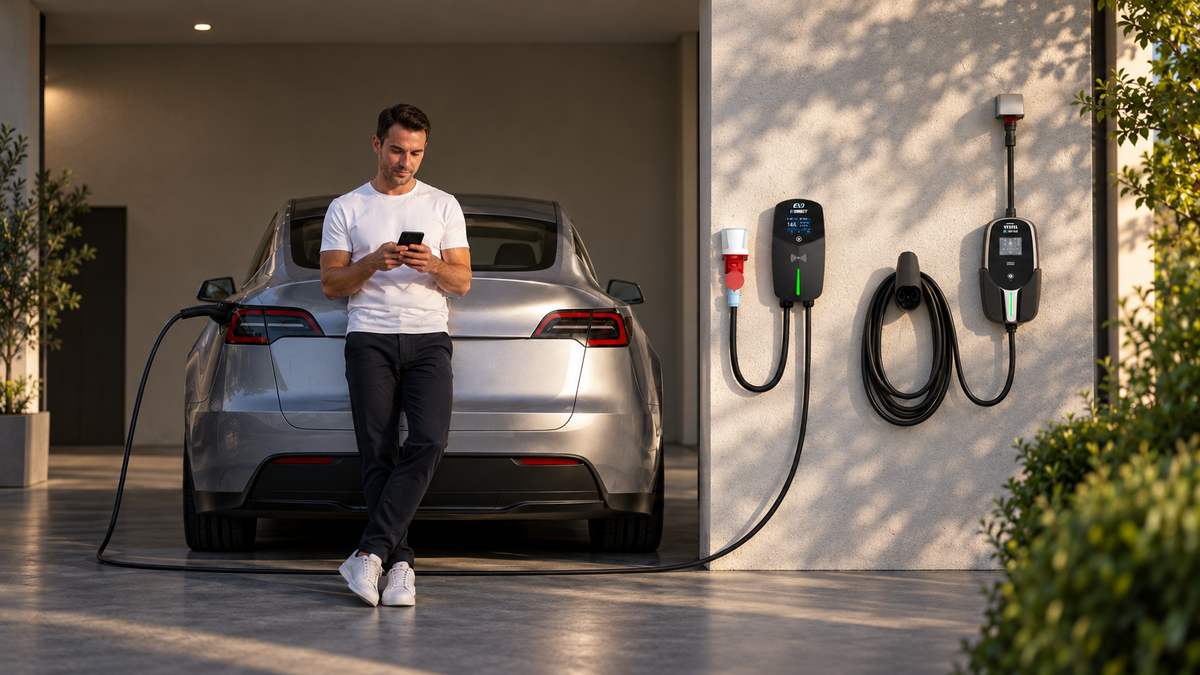
Compare charging speed, installation, cost and safety—and find the setup that fits your home and daily driving.
A wallbox is usually best for permanent daily home charging. A portable EV charger is better for renters, travel, backup charging and drivers who value flexibility. Charging speed depends on the power supply and vehicle—not simply on whether the unit is portable or wall-mounted.
Portable EV Charger vs. Wallbox at a Glance
| Feature | Portable EV Charger | Wallbox |
|---|---|---|
| Best for | Renters, travel, backup and flexible charging | Regular daily home charging |
| Installation | Plugs into a compatible socket | Usually professionally installed |
| Portability | Easy to carry | Remains at one location |
| Typical power | 2.3–11 kW | 7.4–22 kW |
| Initial cost | Usually lower if a suitable socket exists | Higher once installation is included |
| Smart features | Available on selected models | More commonly available |
Not sure where to start?
Choose the charging route that best matches your available socket and daily routine.
Schuko Portable Charger
A flexible option when you have a suitable household socket and do not need higher AC charging power.
View portable chargers →CEE Mobile Wallbox
Choose 7.36 kW or 11 kW models when a compatible CEE supply is available and you want faster charging without a permanent hardwired installation.
Compare CEE chargers →11kW Smart Wallbox
A fixed home-charging option for drivers who charge regularly in the same parking space and want a more integrated setup.
View 11kW wallbox →What Is the Main Difference?
A portable EV charger connects the car to a compatible household or CEE socket. It can be stored in the boot and used at different locations. A wallbox is installed permanently beside a parking space, usually on a dedicated electrical circuit.
Both options normally use a Type 2 connector for European vehicles. The main differences are how the unit receives power, whether it can be moved and which smart-energy features it supports.
Which One Charges Faster?
A wallbox is usually faster than a charger connected to an ordinary household socket, but portable does not automatically mean slow. CEE portable chargers can reach 7.36 kW or 11 kW when connected to a compatible CEE supply.
Estimated time to add 36 kWh before normal charging losses. Actual speed is limited by the electrical supply, charger and vehicle’s onboard AC charger.
Compare 7.36 kW and 11 kW CEE charging options for home and travel use.
Which Option Costs Less?
A portable charger usually has the lower setup cost when a safe, compatible socket already exists near the parking space. A wallbox adds professional installation costs, which may include cable work, circuit protection, load management or an electrical-panel upgrade.
If a new high-power CEE socket must be installed, the price difference may become smaller. Compare the complete project cost:
Which One Is Safer?
A wallbox installed on a dedicated circuit by a qualified electrician is generally the most controlled solution for frequent home charging. A certified portable charger can also be used safely when the socket, wiring, circuit protection and selected charging current are suitable for prolonged EV charging.
The main concern is not portability—it is drawing a high load for many hours through an unsuitable, worn or damaged socket.
- Use a grounded socket rated for the selected current.
- Never exceed the rating of the socket or household circuit.
- Avoid extension leads, multi-socket strips and travel adapters.
- Fully uncoil the charging cable before use.
- Stop charging if the plug or socket becomes unusually hot.
- Ask a qualified electrician to inspect older or uncertain wiring.
Which Charger Is Right for You?
A portable EV charger suits you if:
- You rent your home or expect to move
- You charge at more than one location
- You want a travel or emergency backup
- You already have a suitable Schuko or CEE socket
- You want to avoid a permanent charger installation
A wallbox suits you if:
- You own your home and have dedicated parking
- You charge in the same place every day
- You want a more permanent charging setup
- You value smart access and charging controls
- You prefer tidy, fixed cable storage
Final Verdict
Choose a wallbox for maximum everyday convenience. Choose a portable EV charger for flexibility, travel and lower setup complexity.
For many drivers, the ideal setup is a wallbox at home and a portable charger in the boot. If you only need one, focus on your daily mileage, available electrical supply and the vehicle’s maximum AC charging rate.
Find the Charging Setup That Fits Your Home
Compare portable chargers, CEE mobile wallboxes and a dedicated 11kW wallbox before you decide.
Check your vehicle’s maximum AC charging rate, available socket type and electrical supply before choosing a charger.
Frequently Asked Questions
Is a portable EV charger slower than a wallbox?
Not always. A household-socket charger is usually slower, but a 7.36 kW or 11 kW CEE portable charger can match a wallbox with the same power rating.
Can I use a portable EV charger every day?
Yes, if the charger, socket, wiring and circuit protection are suitable for prolonged EV charging. Ask a qualified electrician if the installation is uncertain.
Is 7 kW enough for home charging?
For many drivers, approximately 7 kW is enough to restore their normal daily driving range overnight. The result depends on battery size, mileage and parking time.
Do I need an electrician for a wallbox?
Yes. A fixed wallbox should be installed and tested by a qualified professional in accordance with local electrical requirements.
Charging speeds are estimates. Always check the limits of your vehicle, charger and electrical supply, and follow local installation requirements.


Share:
What Length Type 2 Charging Cable Do I Need?
Using a Type 2 Cable at Public AC Stations: What Should You Know?